
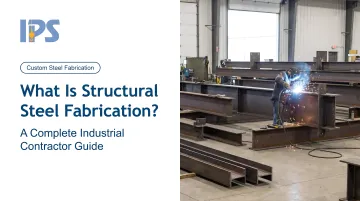
Structural steel fabrication is the process of cutting, bending, welding, and assembling raw steel into structural components — beams, columns, platforms, and frames — built to precise specifications for construction, industrial, and manufacturing projects. It's not general metalwork or simple weld repairs. It's engineered, code-governed production where dimensional accuracy and weld integrity directly determine whether a structure stands safely under load.
This guide covers the full picture: the step-by-step fabrication process, key methods and techniques, industries that rely on it, steel's advantages over competing materials, and what to look for in a fabrication partner.
Key Takeaways
- Structural steel fabrication = cutting, bending, welding, and assembling raw steel into load-bearing structural components
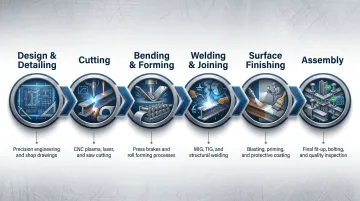
- The process follows a defined sequence: design → cutting → bending/forming → welding → finishing → assembly
- Common methods include plasma cutting, laser cutting, MIG/FCAW welding, and galvanizing for corrosion protection
- Steel outperforms wood and concrete on strength-to-weight ratio, durability, recyclability, and design flexibility
- Certified welders, OSHA compliance, and turnkey capabilities are the baseline for a low-risk fabrication partner
The Structural Steel Fabrication Process: Step by Step
Fabrication begins long before any steel is cut. Precision at every stage determines the safety and integrity of the final structure; a missed dimension in the shop becomes a costly problem during field erection.
Design and Detailing
Every fabrication project starts with shop drawings produced in collaboration with engineers and architects. These translate blueprints into manufacturing-ready specifications for every beam, column, and connection point — exact dimensions, hole locations, weld sizes, and material grades.
Modern fabricators use CAD and BIM software to build 3D structural models. According to AISC's BIM & VDC guide, federated-model clash detection through BIM reduces miscommunication and rework by identifying fit problems before physical work begins — saving significant time and cost downstream.
Cutting the Steel
Raw steel arrives from mills as plates, beams, channels, or angles. Fabricators cut these to exact dimensions using methods selected based on material thickness and precision requirements:
- Band/circular saws — economical straight cuts on standard sections
- Plasma torches — fast and effective on thick plate
- Laser cutters — high precision for thinner steel and complex profiles
- Waterjet — cold cutting with no heat distortion, ideal for sensitive applications
Cutting facilities operate under strict safety protocols given the hazards involved. Once cut, pieces move to forming operations — or directly to welding if no shaping is required.
Bending and Forming
Not every component is flat. IPS's fabrication shop can break, roll, and shear metal — capabilities that cover the full range of forming operations:
- Plate rollers curve steel into cylindrical shapes for tanks, stacks, and architectural arches
- Press brakes create precise angular bends for brackets, channels, and connection hardware
Method selection depends on bend complexity and volume. Repetitive bends justify dedicated machine setups; single one-off angles are typically handled manually. With forming complete, components move to welding — where individual pieces become a unified structure.
Welding and Joining
Welding is the most critical step. Certified welders fuse steel components by applying heat at joining points, creating a single continuous piece. Weld quality directly affects structural load capacity. A poor weld on a load-bearing connection is a structural liability.
Common welding processes used in structural fabrication include:
- SMAW (stick welding) — versatile and portable, widely used in structural and field work
- GMAW/MIG — efficient for repetitive shop welds
- FCAW — high deposition rate, suited for heavier sections and outdoor conditions
- SAW (submerged arc) — high-volume shop welds on beam flanges and long seams
Structural welding is governed by AWS D1.1, which requires documented Welding Procedure Specifications (WPS), Procedure Qualification Records (PQR), and welder performance qualifications. IPS maintains in-house welder certification, keeping its welding personnel qualified for structural work without relying on outside credentialing.
Surface Preparation, Finishing, and Assembly
Before components ship, fabricators clean and coat them. Common treatments include:
- Primer and paint — basic corrosion protection for indoor environments
- Powder coating — durable finish for high-wear surfaces
- Galvanizing — zinc coating for maximum outdoor or corrosive environment protection
Large assemblies are often trial-fitted in the shop before transport. Confirming that all connections align before field erection avoids expensive delays and mismatched bolt patterns on site.
Key Methods and Techniques in Structural Steel Fabrication
Method selection affects cost, precision, material integrity, and timeline. Understanding these options helps project managers ask better questions and set smarter specifications.
Cutting Methods Compared
| Method | Best For | Edge Quality | Heat-Affected Zone |
|---|---|---|---|
| Laser | Thin to medium plate, precision profiles | Excellent | Present |
| Plasma | Thick plate (>16mm), structural thicknesses | Good to excellent | Present |
| Waterjet | Heat-sensitive alloys, precision parts | Excellent | None |
| Saw | Straight stock cuts on beams and shapes | Good | None |
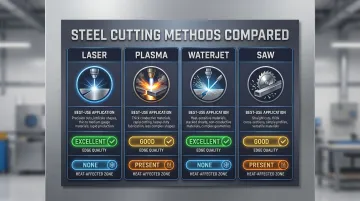
Per Hypertherm's comparison, plasma outperforms fiber laser beyond approximately 16mm thickness in both speed and cost. Waterjet is the right call when edge metallurgy matters or heat input is restricted.
Ask any fabrication partner which cutting method they use for your material thickness, and what drives that decision.
Welding Processes for Structural Steel
Process selection affects weld strength, deposition speed, and suitability for different joint configurations:
- SMAW: best for field-flexible and access-limited joints
- GMAW/MIG: efficient for repetitive fillet and groove welds in shop settings
- FCAW: available in self-shielded modes for outdoor and heavy-section work
- SAW: highest deposition rate for flat-position welds like beam flange-to-web connections
All processes must be qualified under AWS D1.1, with documented WPS/PQR records maintained throughout the project.
Quality Control and Inspection
Quality control in structural fabrication isn't optional. A sound QC program includes:
- Dimensional checks against shop drawings at multiple production stages
- Visual weld inspections after each weld pass
- Ultrasonic Testing (UT): detects internal flaws such as lack of fusion, porosity, and slag inclusions
- Magnetic Particle Testing (MT): finds surface and near-surface cracks in ferromagnetic steel
Documentation matters just as much as inspection. Material Test Reports (MTRs), welder qualification records, and inspection logs create traceability that project specifications and compliance audits require.
Material Selection and Steel Grades
Steel grade selection depends on load requirements, environmental exposure, and connection design — and it directly shapes what your QC program needs to verify. Common structural grades:
| Grade | Yield Strength | Typical Use |
|---|---|---|
| A992 | 50 ksi | Wide-flange beams and columns |
| A572 Gr. 50 | 50 ksi | Shapes, HP sections, plates |
| A36 | 36 ksi | Plates, bars, miscellaneous connections |
Specifying the wrong grade can compromise structural integrity or drive unnecessary cost. When evaluating fabricators, ask how they approach grade selection — a shop that ties material choice to connection design and load conditions brings real engineering value to the project.
Industries and Applications for Structural Steel Fabrication
Structural steel fabrication touches nearly every major industrial and commercial sector. The specific application determines the required specifications, tolerances, and finishing standards.
Industrial Manufacturing and Processing
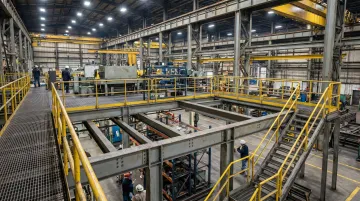
This is where the bulk of IPS's fabrication work lives. Manufacturing facilities require a wide range of structural steel components to keep operations running safely:
- Mezzanines and equipment platforms
- Industrial stairs, catwalks, and handrails
- Conveyor supports and equipment frames
- Structural supports for machinery installations
These elements must withstand constant heavy loads, vibration, and industrial conditions. Fabrication tolerances are tighter than they look — a platform that's a quarter-inch out of level creates alignment problems for the equipment it supports.
Construction, Energy, and Infrastructure
Structural steel is foundational to multiple high-stakes sectors:
- Commercial construction — building frames, trusses, beams, columns
- Energy — transmission towers, wind turbine frames, oil and gas platforms
- Infrastructure — bridges, stadiums, transportation systems
AISC notes that domestic mills produce roughly 10 million tons of structural steel annually, and offsite fabrication can compress construction schedules by up to 40–50% compared to cast-in-place alternatives.
Automotive, Mining, and Shipbuilding
Structural steel also underpins industries where the operating environment is unusually demanding:
- Automotive plants rely on it for safety structures, body frames, and fixture supports
- Mining operations use it for rails, grating, and underground structural systems
- Shipbuilding depends on it for hulls, decks, frames, and bulkheads
Each sector comes with its own code requirements and material specifications. A fabricator without direct experience in your industry will face a steep learning curve — and your project timeline will absorb the cost of that education.
Key Advantages of Structural Steel Over Other Materials
Strength-to-Weight Ratio and Design Flexibility
Steel's high strength-to-weight ratio allows engineers to span longer distances with smaller members. That means larger open floor areas, reduced foundation loads, and faster erection — without the bulky load-bearing walls concrete construction typically requires.
Steel can be fabricated into nearly any shape — curved, angular, fully custom — and that flexibility is difficult to replicate in concrete and impossible in wood at industrial scale.
Durability, Safety, and Low Maintenance
Structural steel holds up where other materials fail:
- Won't rot, warp, or attract insects like wood does
- Non-combustible; intumescent coatings can achieve up to 4-hour fire ratings
- Meets demanding safety codes across industrial applications
- Damage is visible and repairable, keeping long-term maintenance costs in check
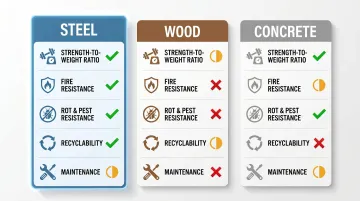
That last point matters more than most buyers realize. Materials that degrade from the inside out — concrete with rebar corrosion, wood with hidden rot — create costly surprises. Steel keeps its condition transparent.
Sustainability and Recyclability
According to the World Steel Association, steel is the world's most recycled material — approximately 650–700 million tonnes of steel scrap were recycled in 2021 alone. Steel can be melted down and reused indefinitely without loss of mechanical properties.
Fabrication scrap goes straight back into the supply chain. For industrial buyers with sustainability targets, structural steel makes a compelling material choice.
How to Choose the Right Structural Steel Fabrication Partner
A poor fabrication partner delivers dimensional errors, failed inspections, rework costs, and delays. The partner you choose shapes the outcome as directly as the design does.
Certifications, Safety Compliance, and Welder Qualifications
Look for these non-negotiables:
- Certified welders — in-house certification is a strong signal; ask whether welders hold current AWS D1.1 qualifications
- AISC certification — verifies a documented quality management system, personnel qualifications, and procedural compliance
- OSHA/TOSHA-compliant safety program — particularly important for fabrication shops where cutting and welding hazards are constant
IPS has maintained OSHA/TOSHA-compliant safety policies since its founding in 1986, and performs in-house welding certification for its welders — the kind of documented internal standard that industrial clients should look for when evaluating fabrication partners.
Turnkey Capabilities and Single Point of Accountability
Managing separate contractors for design, fabrication, and installation creates coordination gaps. When something doesn't fit on site, every subcontractor points at the others.
A turnkey partner who handles design, fabrication, and installation under one contract removes that problem entirely. IPS's model — complete industrial project management from ground zero through plant start-up — is built around this principle: fewer players, no layered fees, and clear accountability at every stage.
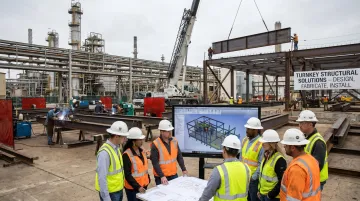
For plant engineers coordinating fabrication alongside equipment installation or facility construction, a single point of contact is a risk management decision, not just a scheduling convenience.
Experience, Project Track Record, and Cost Transparency
Before committing to a fabrication partner, ask:
- Can you show examples of similar industrial projects?
- Do you own your fabrication equipment, or subcontract it?
- What's your current shop capacity and lead time for a project of this scope?
- Can you provide a cost breakdown by material, labor, cutting, finishing, and transport?
These questions also surface cost clarity early. Structural steel material was priced at approximately $2,477 per ton as of late 2025 (per Gordian data), but that figure excludes fabrication labor, cutting, finishing, and erection. Use per-kg estimates for rough budgeting only — always request a detailed, project-specific quote.
Frequently Asked Questions
What is structural steel fabrication?
Structural steel fabrication is the process of cutting, bending, welding, and assembling raw steel into load-bearing structural components (beams, columns, platforms, and frames) for use in construction, manufacturing, and industrial projects. It follows a defined sequence governed by engineering specifications and welding codes.
What do structural steel fabricators do?
Fabricators read shop drawings, select and cut steel to specification, weld and assemble components, perform quality inspections, apply protective coatings, and coordinate delivery and on-site erection. Full-service fabricators also handle design detailing and installation as part of a turnkey scope.
What is the difference between fabricated steel and structural steel?
"Structural steel" refers to the material category — steel engineered for load-bearing applications. "Fabricated steel" refers to structural steel that has already been cut, shaped, welded, and assembled into specific components for a project.
What is prefab structural steel?
Prefab (prefabricated) structural steel refers to components manufactured and assembled off-site in a controlled fabrication shop, then transported to the project site for installation. This approach reduces on-site labor, compresses overall schedules, and improves quality control compared to field fabrication.
How long does it take to fabricate structural steel?
Fabrication timelines vary based on project complexity, component size, quantity, and shop capacity — simple components may be ready in days, while large industrial structures take weeks to months. Raise timeline requirements early, since shop backlogs and material lead times both affect scheduling.
What is the cost per kg of structural steel fabrication?
Per-kg figures are useful only for rough early budgeting. Actual costs vary based on steel grade, cutting method, weld complexity, finishing requirements, and project volume, so no reliable public benchmark exists. Always require a detailed line-item quote before committing to a project.