
Introduction
Oversize load permits aren't optional — any vehicle or load exceeding standard size or weight limits on U.S. roads requires one before the wheels turn. What catches many project managers off guard isn't the requirement itself, but the cost.
Permit fees are one of the most variable line items in any industrial transport budget. A simple single-state move might cost $15 in permit fees. A multi-state haul of heavy industrial machinery can run $5,000 or more — before escort vehicles, bridge analysis, or route surveys are factored in.
This guide covers:
- Typical permit fee ranges by load type
- The factors that drive costs up or down
- State-by-state fee structures for Texas, Florida, Louisiana, and Pennsylvania
- Hidden costs that derail budgets when not anticipated early
Key Takeaways
- Oversize permit fees range from $5–$25 for basic single-state moves to $5,000+ for multi-state, overweight, or super-load hauls
- The biggest cost drivers: load width, height, length, gross weight, state count, and escort requirements
- Single-trip permits cost more per move; annual permits reduce per-trip costs for repeat corridors
- Hidden costs like escorts, bridge analysis, route surveys, and county fees can equal or exceed the base permit fee
How Much Does an Oversize Load Permit Cost?
There is no national oversize permit fee. Each state sets its own fee structure independently, and costs vary dramatically based on load dimensions, weight, and route.
Rough ranges to anchor your budget:
- Single-state, minor excess dimensions: $15–$500
- Multi-state, overweight + oversize: $500–$5,000+
- Super-load or complex haul (per state): $1,000–$5,000+
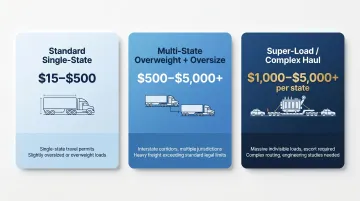
Two budgeting mistakes cause most cost surprises: assuming one permit covers all states, and ignoring fees beyond the base application.
Standard Oversize Permit — Single State, Minor Dimensions
This tier covers loads slightly exceeding legal limits — typically width up to 12–14 ft, length up to 85–95 ft — within a single state.
State fee examples:
- Florida: $5 (up to 12 ft wide), $15 (up to 14 ft wide), $25 (over 14 ft wide)
- California: $16 flat fee for a 7-day single-trip permit
- Tennessee: $20 base fee for excess width up to 14 ft
Best for: one-off moves of construction equipment, agricultural loads, or industrial machinery that marginally exceeds legal dimensions in one state.
Mid-Range Permit — Overweight + Oversize, Multi-State
This tier covers loads exceeding both size and weight thresholds across two or three states. A three-state move in this tier can hit $3,000 before any add-ons.
State fee examples:
- Texas: Single-trip fees range from $60 (oversize, legal weight) to $470 (200,001–254,300 lbs, including vehicle supervision fee)
- Tennessee: Annual overweight permits run $750 (up to 100,000 lbs) through $3,500 (up to 165,000 lbs)
Best for: crane or transformer transport, multi-state machinery relocations, and hauls triggering both oversize and overweight fees.
Super-Load Permit — Complex or Extreme Haul
Super-load thresholds are state-defined, not federal. State fee examples:
- Texas: Applies to loads over 254,300 lbs GVW
- Tennessee: Structures Division approval required above 165,000 lbs
- Pennsylvania: $68 base surcharge plus $12 per county
At this level, permits require paid engineering reviews, route surveys, and often law enforcement escort. Total permit-related costs commonly run several thousand dollars per state, with processing timelines measured in weeks — costs covered in the next section alongside escort and survey fees.
Key Factors That Affect Oversize Load Permit Costs
Permit pricing is driven by load characteristics, route decisions, and each state's fee structure. Understanding these levers is the most direct way to control total permitting costs.
Load Width, Height, and Length
Width is typically the most expensive dimension to exceed. Most states apply tiered surcharges, and the 14-foot mark is the most consequential breakpoint across multiple states:
| State | Under 14 ft | Over 14 ft | Change |
|---|---|---|---|
| Pennsylvania | $46 base | $97 base | +111% |
| Florida | $15 | $25 | +67% |
| Tennessee | $20 | $30 | +50% |
Width also triggers escort requirements (Texas mandates one escort at 14 ft 1 in, two escorts above 16 ft), which multiplies the real cost impact of crossing that threshold.
Gross Weight and Axle Configuration
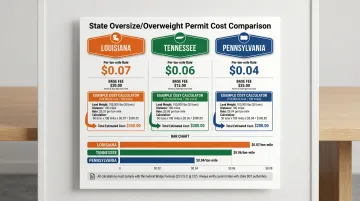
Several states price overweight permits on a per-ton-per-mile basis, meaning costs scale with both the excess weight and the route distance:
| State | Per-Ton-Mile Rate | Base Fee |
|---|---|---|
| Louisiana | $0.07 | $10/day |
| Tennessee | $0.06 | $20 |
| Pennsylvania | $0.04 | $46 or $97 |
A 100,000-lb load traveling 100 miles would incur approximately $70 in ton-mile fees in Louisiana, $60 in Tennessee, and $40 in Pennsylvania — before base permit fees are added. Axle count and spacing also matter: the Federal Bridge Formula governs weight distribution, and loads that fail the formula require additional permits or axle configuration changes.
Number of States and Permit Type
Weight and dimension costs only tell part of the story — every state crossed adds its own permit fee on top. States don't refund permit fees, even if the permit goes unused, so route planning matters as much as the fees themselves.
Multi-state hauls benefit from permit timing options that match project duration:
- Texas: 30-, 60-, and 90-day intermediate permits at $120, $180, and $240
- Louisiana: Semi-annual and monthly permit options available
- All states: Single-trip permits available when recurring moves don't justify longer terms
Routing to minimize miles through high-fee states — or choosing permit durations that match actual project windows — can cut total permitting costs on complex multi-state moves.
Escort and Pilot Car Requirements
Escort costs can match or exceed the base permit fee. The table below shows how escort costs stack up across common scenarios:
| Escort Type | Rate | Example Cost |
|---|---|---|
| Tennessee Highway Patrol | $65/hr + $0.13/mile (2-officer min) | ~$1,092 for 200-mile, 8-hour move |
| Private pilot car (single) | $1.50–$3.00/mile | $450–$900 over 300 miles |
| Private pilot cars (two required) | $1.50–$3.00/mile each | $900–$1,800 over 300 miles |
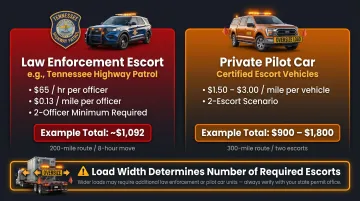
Private pilot car services are permitted in some states as an alternative to law enforcement escorts, which can reduce cost. Where THP is mandatory — as in Tennessee for certain load dimensions — there's no substitute.
State-by-State Permit Fee Overview
Permit fees are set by state legislatures and subject to change. Verify all figures against current official DOT fee schedules before budgeting. Links to each state's permit portal are included below.
Texas
Texas uses a combination of flat-tier weight fees and a unique county-count pricing model for annual permits. TxDMV's fee schedule shows:
Single-trip fees by weight:
| Weight Range | Total Permit Fee |
|---|---|
| Oversize, legal weight | $60 |
| 80,001–120,000 lbs | $210 |
| 120,001–160,000 lbs | $285 |
| 160,001–200,000 lbs | $360 |
| 200,001–254,300 lbs | $470 (includes vehicle supervision fee) |
Annual over-axle tolerance permits range from $270 (1–5 counties) to $1,095 (101–254 counties). Route planning directly controls which county tier you fall into — the difference between a 5-county and a 100-county permit is $825 on a single annual filing.
Vehicle supervision fees for loads over 200,000 lbs add $100 (no bridges on route) or $500 (private engineer analysis required).
Florida
Florida Administrative Code 14-26.008 codifies a tiered fee structure by load dimension and weight:
Oversize trip permit fees scale with width: $5 (up to 12 ft), $15 (up to 14 ft), and $25 (over 14 ft).
Overweight trip permit fees range from $5 (up to 95,000 lbs) to $250 (over 199,000 lbs).
Florida permits self-issuance through its online PAS system for loads up to 16 ft wide, 18 ft high, 150 ft long, and 200,000 lbs. Loads above those thresholds require direct Permit Office involvement.
Louisiana
Louisiana uses variable pricing that scales with distance — making route length a direct cost driver.
- Oversize single-trip: $10 per day
- Overweight single-trip: $0.07 per ton-mile (minimum $10)
- Annual oversize/overweight (non-divisible equipment): $2,500
Louisiana also offers commodity-specific annual permits at distinct rates — agronomic/horticulture hauls at $100, bagged rice at $500 — with geographic and weight restrictions attached. Current rates and restrictions are published at Louisiana DOTD.
Pennsylvania
PennDOT's fee schedule (effective July 1, 2025) applies a base fee plus per-ton-mile charges for overweight loads. Permits are obtained through PennDOT's APRAS online portal at apras.penndot.pa.gov.
- Single-trip, under 14 ft wide: $46 + $0.04/ton-mile (overweight)
- Single-trip, over 14 ft wide: $97 + $0.04/ton-mile (overweight)
- Super-load surcharge: $68 + $12 per county
- Annual construction equipment: $707
Pennsylvania enforces federal axle weight limits (20,000 lbs single axle, 34,000 lbs tandem). For cross-state super-loads, the $12-per-county surcharge adds up fast — a haul crossing 10 counties adds $120 before mileage charges.
Single-Trip vs. Annual Oversize Load Permits
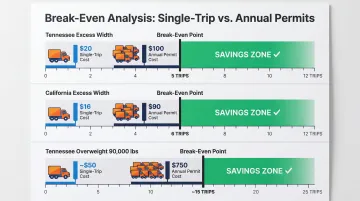
Single-trip permits cost more per move but require no upfront commitment. Annual permits demand more capital initially — but pay off once trip volume crosses a break-even threshold. The examples below show exactly where that line falls.
Break-even examples:
Tennessee excess width (up to 14 ft):
- Single-trip: $20 | Annual: $100
- Break-even: 5 trips
California single-trip vs. annual:
- Single-trip: $16 | Annual: $90
- Break-even: 6 trips
Tennessee overweight (90,000 lbs, 100-mile route):
- Single-trip: ~$50 | Annual: $750
- Break-even: ~15 trips
When to use single-trip permits:
- One-off equipment relocations or factory moves
- Loads that vary significantly in size between hauls
- Routes that change from project to project
When annual permits make sense:
- Fleets or companies running consistent oversize corridors
- Operations with predictable trip frequency (5+ trips/year on the same route)
- Multi-commodity haulers in states with broad annual permit envelopes
For multi-state hauls — a common scenario for fleet operators considering annual permits — it's worth knowing that the Western Regional Trip Permit ended on December 31, 2018. Individual permits from each state are now required, with no active regional program to replace it.
Hidden Costs and Budgeting Considerations
The base permit fee is rarely the full story. These line items regularly catch project managers off guard.
Escort and Pilot Car Fees
Most states mandate 1–3 escort vehicles based on load width, height, and length. Costs vary by whether law enforcement or private pilot cars are required:
- Tennessee Highway Patrol: $65/hr + $0.13/mile, two-officer minimum (~$1,092 for a 200-mile, 8-hour move)
- Private pilot cars: $1.50–$3.00/mile (market-priced, not state-set)
- Two private escorts over 300 miles: $900–$1,800 in escort costs alone
For loads near escort thresholds, load configuration engineering (trailer selection, disassembly, orientation) to stay below 14 ft width can eliminate escort requirements entirely — often saving more than the engineering cost itself.
Bridge Analysis, Route Surveys, and Permit Amendments
Super-loads and heavy industrial equipment typically require engineering reviews before permits are issued:
- Texas vehicle supervision fee: $100 (no bridges on route) or $500 (private engineer analysis)
- Tennessee bridge fees: $100 (165,000–250,000 lbs), $300 (251,000–500,000 lbs), actual cost above 500,000 lbs
- Route inspection certification: Required in Texas for loads over 20 ft wide, over 18 ft 11 in tall, or over 125 ft long
Mid-project changes — route amendments, load dimension adjustments — trigger additional permit fees and restart portions of the review process. Locking in load specs and route before permit applications go in avoids this cost entirely.
Working with a Provider That Has Permitting Expertise
For complex industrial equipment moves (factory relocations, heavy machinery transport, multi-state hauls involving specialized rigging) the permitting process involves enough variables that coordination gaps become expensive. IPS has managed oversized load permitting for industrial clients across the U.S. since 1986, with in-house expertise covering permitting, routing, and transport under a single turnkey engagement. One point of contact across all three functions means fewer revision cycles, no conflicting permit timelines between vendors, and clearer accountability when a route needs to change mid-move.
Frequently Asked Questions
What's the widest load you can haul without a permit?
The standard legal width limit on the National Network is 102 inches (8 ft 6 in), per FHWA — and no state can impose a narrower limit on those routes. Loads exceeding 102 inches generally require an oversize permit. Hawaii is the only exception, with a baseline of 108 inches.
How much does an oversize load permit cost in Texas?
Single-trip permits range from $60 (oversize, legal weight) to $470 (200,001–254,300 lbs). Annual permits use a county-count model ranging from $270 to $1,095. Total cost is highly route-dependent — verify current rates at TxDMV.
How much does an oversize load permit cost in Florida?
Florida oversize trip permits run $5–$25 depending on load width. Overweight trip permits range from $5 to $250 based on gross weight tiers. Current rates are published in Florida Administrative Code 14-26.008.
How much does an oversize load permit cost in Louisiana?
Oversize single-trip permits cost $10 per day. Overweight fees run $0.07 per ton-mile (minimum $10). The annual oversize/overweight permit for non-divisible equipment is $2,500. Check current rates at Louisiana DOTD.
Do contractors charge to pull permits?
Yes. Permit service agencies charge a service fee on top of the state's application fee, covering route research, application preparation, and multi-state coordination. For complex or multi-state hauls, that expertise prevents the costly delays that come from errors or missing documentation.
How do I get an oversize load permit in Pennsylvania?
Pennsylvania oversize/overweight permits are issued through PennDOT's APRAS online portal. Have your load dimensions, total weight, axle configuration, and planned route ready before applying.