
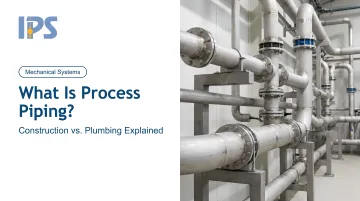
These two systems serve fundamentally different purposes, operate under completely different regulatory codes, and require different levels of certification to design and install. Confusing them isn't just a technical error — it creates real liability.
This article covers what process piping actually is, how it differs from plumbing, where it sits within industrial construction, and what to look for when selecting a contractor to handle it.
Key Takeaways
- Process piping moves industrial substances — chemicals, steam, gases, food products — through a manufacturing process, not a building's utility systems
- ASME B31.3 governs process piping — not local plumbing codes — and requires certified pipefitters and qualified welders
- Process piping is classified as a mechanical discipline in industrial construction, alongside equipment installation and structural steel
- Key documents include the P&ID (system map) and PMS (approved materials list)
- Hiring a contractor without ASME qualifications and relevant material experience creates serious safety and compliance risk
What Is Process Piping?
Process piping is an engineered network of pipes, valves, fittings, and instruments designed to transport raw materials, intermediary substances, and finished products through the stages of an industrial or manufacturing process.
The operative word is process. These systems move materials through the actual production operation, not through a building's utility infrastructure.
ASME B31.3 — the governing standard for process piping — covers piping in petroleum refineries, chemical plants, pharmaceutical facilities, hydrogen plants, textile mills, paper and pulp operations, semiconductor fabrication, and cryogenic plants.
What these systems carry goes well beyond water:
- Caustic soda, nitric acid, sulfuric acid, hydrochloric acid
- Petroleum products and diesel fuel
- Compressed gases and cryogenic nitrogen
- Refrigerants and steam
- Food-grade liquids, dairy products, beverages
- Fluidized solids
Each substance carries distinct temperature limits, pressure ratings, and chemical compatibility requirements. That's why material selection and connection methods vary significantly from one system to the next.
The Full System: Components Beyond the Pipe
A process piping installation isn't just the pipe itself. It's a complete engineered system integrating:
- Pipes and tubing selected by material, nominal size, and wall thickness
- Fittings (elbows, tees, reducers, couplings) for routing and directional changes
- Valves — gate, ball, globe, butterfly, and check types — for flow control
- Flanges that connect pipe sections to equipment and allow for inspection access
- Pumps sized to overcome friction losses and maintain flow rates
- Instruments and gauges tracking pressure, temperature, and flow in real time
- Pipe supports and anchors engineered to absorb thermal expansion and vibration
Every component must be selected based on what's flowing through the pipe and the specific operating conditions. A valve rated for water service has no place in a sulfuric acid line.
Process Piping vs. Plumbing: Key Differences
The fundamental distinction is function. Plumbing handles building support — domestic water supply, sanitary drainage, restroom fixtures. Process piping serves the production operation itself.
That difference in function drives every other difference between the two systems.
Governing Standards
| System | Governing Code | Scope |
|---|---|---|
| Plumbing | Local/state plumbing codes (UPC, IPC) | Potable water, sanitary drain, gas |
| Building services piping | ASME B31.9 | Low-pressure utilities, nonflammable/nontoxic |
| Process piping | ASME B31.3 | Industrial fluids, broad temp/pressure range |
| Power piping | ASME B31.1 | Steam and energy systems |
| Pipeline transportation | ASME B31.4 / B31.8 | Long-distance liquid and gas transmission |
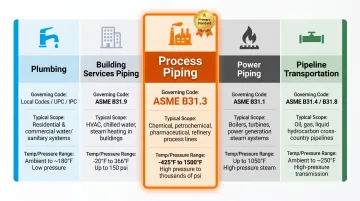
ASME B31.9 (building services) caps out at 150 psig for gases and 350 psig for liquids, with temperature limits of 200°F and 250°F respectively. ASME B31.3 has no comparable ceiling — it covers cryogenic service down to -452°F and high-temperature service up to 1,200°F depending on materials. That range matters when you're designing for chemical processing, pharmaceutical production, or high-temperature industrial service.
Materials
Plumbing uses copper, PVC, CPVC, brass, and cast iron — materials suited for chemically stable water and wastewater. Process piping demands more:
- Carbon steels (ASTM A53, A106) for general industrial service
- Austenitic stainless steel (304L, 316L) for corrosive and food-grade applications
- Hastelloy C276, Alloy 20, and Monel for highly aggressive chemicals
- Inconel 600 for elevated temperature service up to 1,200°F
- Copper and aluminum for cryogenic systems
Chemical compatibility, pressure class, and operating temperature determine material selection — not preference.
Workforce Requirements
Licensed plumbers are qualified to handle building plumbing. Process piping is a different trade entirely.
According to the Bureau of Labor Statistics, pipefitters and steamfitters specifically install and maintain pipes carrying chemicals, acids, and gases in manufacturing and industrial settings. They complete 4–5 year apprenticeships focused on industrial systems — not residential plumbing.
Their welding qualifications fall under ASME Section IX, which governs welding procedure specifications and welder performance qualifications for pressure piping. That's a separate credential from anything a licensed plumber holds.
The consequences of a process piping failure aren't comparable to a leaking faucet. The 2012 Chevron Richmond refinery incident — caused by a carbon steel pipe failure from sulfidation corrosion — resulted in a catastrophic vapor cloud and fire. The right material, selected by qualified engineers and installed by certified pipefitters, is what prevents it.
How Process Piping Fits Into Industrial Construction
In industrial construction, process piping is classified as a mechanical discipline — not plumbing, and not a generic utility trade.
It's scoped alongside equipment installation, structural steel, and pressure vessel work. When a plant engineer asks whether process piping is considered mechanicalThe answer is yes — definitively. Industrial pipefitters and mechanical contractors perform this work, not licensed plumbers.
The answer is yes. Industrial pipefitters and mechanical contractors perform this work, not licensed plumbers.
Multiple Piping Codes on a Single Project
A large industrial facility rarely has just one type of piping. A food processing plant, for example, might simultaneously require:
- Process piping (ASME B31.3) — transporting food products, cleaning chemicals, and process water
- Power/steam piping (ASME B31.1) — distributing steam from boilers for heating and processing
- Refrigeration piping (ASME B31.5) — supporting cold storage and chilling systems
- Building services piping (ASME B31.9) — handling restrooms, wash stations, and HVAC utilities
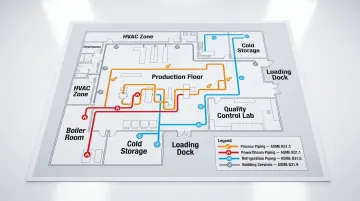
Each of those systems requires different materials, design standards, inspection protocols, and qualified personnel. OSHA's Process Safety Management standard (29 CFR 1910.119) requires employers to maintain P&IDs documenting these interconnected systems — and to manage their mechanical integrity through formal inspection programs.
IPS coordinates these overlapping scopes under a single management team, integrating process piping with equipment installation, structural steel, and electrical work. This eliminates the handoff gaps that occur when disciplines are split across multiple contractors.
Key Components of a Process Piping System
Engineering Documents
Two documents drive every process piping project:
- Piping and Instrumentation Diagram (P&ID) — A graphical map of every pipe, valve, instrument, and piece of equipment in the system. Standardized under ANSI/ISA 5.1-2024, P&IDs are required by OSHA PSM and serve as the primary reference for installation, operation, and maintenance.
- Piping Material Specification (PMS) — Defines which materials, fittings, flanges, and valves are approved for each service. A complete PMS eliminates guesswork on the job site before installation begins.
- Valve Matrix (VM) / Valve Schedule — Lists all valves with type, size, pressure rating, and material requirements.
These aren't optional administrative documents. Without them, field crews make assumptions — and assumptions in process piping lead to rework, failures, and regulatory violations.
Supporting Components
The documents above define what gets installed. These physical components determine whether the system holds up under real operating conditions:
- Pipe supports and anchors — must be designed per MSS-SP-58 to account for thermal expansion, dead loads, and vibration
- Insulation — controls heat loss or gain and protects workers from contact with hot pipe surfaces
- Heat tracing — maintains fluid temperature in cold environments where freezing or viscosity change would disrupt flow
Common Types of Process Piping in Industrial Settings
Within a single manufacturing facility, multiple process piping types often coexist — each serving a different function and requiring different materials.
| Piping Type | Typical Material | Common Industries |
|---|---|---|
| Steam piping | Carbon steel (ASTM A106) | All manufacturing, food processing |
| Sanitary/food-grade | 304 stainless steel | Food, beverage, pharmaceutical, dairy |
| Chemical/acid piping | Hastelloy C276, Alloy 20, Monel | Chemical processing, rubber manufacturing |
| Cryogenic piping | Copper, aluminum | Semiconductor, industrial gas |
| Refrigerant piping | Copper, carbon steel | Cold storage, food processing |
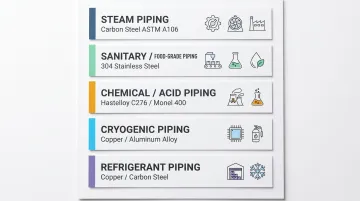
Sanitary piping carries its own compliance layer. 3-A Sanitary Standards — developed cooperatively by sanitarians, equipment fabricators, and processors since the 1920s — require 304 stainless steel for all food-contact surfaces. FDA's 21 CFR Part 110 cGMP requirements add further obligations for food processing environments.
IPS fabricates food-grade sanitary piping and equipment in-house and maintains current FDA compliance for food-grade procedures — work it has performed for food and beverage manufacturers including ConAgra Foods, Sara Lee, Taylor Farms, and Coca-Cola.
Material selection is only part of the picture. Process piping also breaks down by function:
- Utility lines supply supporting services — compressed air, plant water, and nitrogen
- Process lines carry materials directly through each stage of production
- Instrumentation lines are small-bore runs used for measurement and control signals
The category a pipe falls into affects design standards, testing requirements, and installation procedures.
What to Look for in a Process Piping Contractor
Because process piping handles production-critical and often hazardous materials, contractor selection has direct consequences for safety, regulatory compliance, and uptime. Three qualifications are non-negotiable:
ASME Section IX welder certification — in-house preferred. Ask for documented Welding Procedure Specifications (WPS) and Welder Performance Qualifications (WPQ). If a contractor can't produce these, walk away.
Material-specific experience — carbon steel experience alone doesn't qualify a contractor to work with Hastelloy, Monel, or food-grade stainless. Verify they've worked with the specific materials your process requires.
Post-installation testing capability — ASME B31.3 requires hydrostatic testing at 1.5 times design pressure or pneumatic testing at 1.1 times design pressure. A contractor who skips this step creates liability you'll inherit.
The Case for a Single-Contract Approach
When process piping is one of several concurrent scopes — alongside equipment installation, structural steel, and instrumentation — splitting those disciplines across multiple contractors creates coordination risk. Gaps between scopes become disputes over accountability. Schedule delays cascade across trades. Nobody owns the problem.
A turnkey contractor who handles all of those disciplines under one contract removes that dynamic entirely. IPS's model integrates mechanical systems, piping, structural fabrication, equipment installation, and project management under one team — eliminating the accountability gaps that fragmented contracting creates. With in-house welder certification, OSHA/TOSHA-compliant safety procedures, and 40 years of industrial project experience across food processing, automotive, rubber manufacturing, and more, IPS manages these multi-discipline scopes without the disputes that come from splitting work across separate contracts.
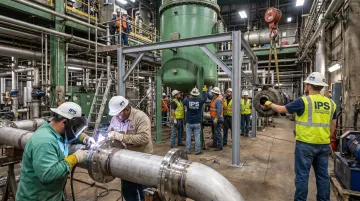
Confirm any contractor candidate understands ASME B31.3 for process piping and B31.1 for power piping, has worked with P&ID and PMS documentation, and can execute post-installation pressure testing. A contractor who clears all three has the credentials to take ownership of the scope — not just the work order.
Frequently Asked Questions
What is a process piping system and how does it work?
A process piping system is an engineered network of pipes, valves, fittings, and instruments that transports industrial materials — liquids, gases, chemicals, steam — through specific stages of a manufacturing operation. The system operates under controlled pressure, temperature, and flow parameters set at the design stage.
What is the ASME code for process piping?
ASME B31.3 is the primary code governing process piping, covering design, materials, fabrication, testing, and inspection. Other codes apply based on function:
- B31.1 — power piping (steam and energy systems)
- B31.9 — low-pressure building services piping
The applicable code depends on the piping's function and service conditions.
How are process piping systems installed?
Installation follows a defined sequence — P&ID and routing design, material selection per the PMS, certified welding, pipe support installation, and pressure testing. All work is performed by qualified pipefitters under ASME-certified welding procedures.
Is process piping considered mechanical?
Yes. Process piping is classified as a mechanical discipline in industrial construction, performed by industrial pipefitters and mechanical contractors — not licensed plumbers. It's typically scoped alongside equipment installation, structural steel, and pressure vessel work.
How does process piping differ from plumbing, pipeline, and power piping?
Each system serves a distinct function under a different code:
- Plumbing — domestic building water and waste; governed by local codes
- Process piping — industrial substances within a facility; governed by ASME B31.3
- Power piping — steam and energy systems; governed by ASME B31.1
- Pipeline transportation — long-distance fluid movement between facilities; governed by ASME B31.4 or B31.8
What do PMS and VM mean in piping?
PMS stands for Piping Material Specification — a document defining approved materials, fittings, and components for each service in a process piping system. VM (Valve Matrix or Valve Schedule) catalogs all valves in the system with their type, size, pressure rating, and material requirements.