Introduction
Industrial electrical installations are the backbone of every manufacturing facility, production line, and processing plant. These systems span incoming utility service and power distribution, motor control, automation, lighting, and safety infrastructure — each layer dependent on the ones below it.
Unlike residential or commercial systems, industrial installations operate under high voltage, continuous load, and harsh environmental conditions. A gap in any one component creates downstream consequences: production stoppages, equipment damage, safety incidents, and regulatory violations.
According to Siemens' 2024 True Cost of Downtime study, unplanned downtime costs Fortune Global 500 industrial companies approximately $1.5 trillion annually — roughly 11% of total turnover. Automotive facilities alone lose $2.3 million per hour when the line goes down.
This article covers the essential components found in industrial electrical installations — from service entrance equipment and switchgear to motor controls, VFDs, and grounding systems — with what to look for when planning or evaluating each one.
Key Takeaways
- Industrial electrical systems deliver reliable, safe power to heavy machinery, automated equipment, and critical infrastructure under demanding conditions
- Transformers, switchgear, MCCs, cabling/conduit, and grounding systems each serve distinct but interdependent functions within a complete installation
- Poor component specification or improper installation leads to unplanned downtime, equipment damage, code violations, and safety incidents
- Effective planning covers load analysis, site conditions, NEC/OSHA compliance, and scalability before any component is specified
Why Getting the Components Right Is Critical
An electrical failure in a manufacturing facility is not a minor inconvenience — it's a production stoppage with a measurable dollar figure attached. Automotive plants lose $2.3 million per hour. SME manufacturers can see costs reaching $150,000 per hour. Both figures reflect documented averages, not outliers.
The safety stakes are equally serious. NFPA research published in 2025 documented 142 worker deaths from electrical exposure in 2023, with industrial facilities accounting for 17% of all electrical fatalities.
How Component Failures Cascade
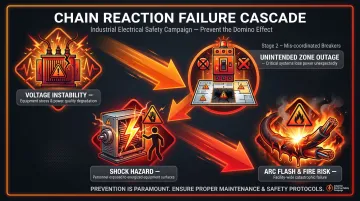
Industrial electrical components are deeply interdependent. A failure in one area rarely stays contained:
- An undersized transformer creates voltage instability that damages sensitive control equipment downstream
- Improperly coordinated breakers trip the wrong upstream device, taking out an entire production zone instead of isolating one circuit
- Inadequate grounding allows fault current to travel through equipment frames, creating shock hazards for workers
- Overloaded cabling generates heat that degrades insulation over time, eventually causing arc flash events
According to Grace Technologies' analysis of industrial electrical failures, loose connections alone account for 30.3% of all industrial electrical failures — driven by vibration, thermal cycling, and poor installation practices. Moisture and insulation degradation together contribute another 27%.
Every component covered in this guide — from transformers and switchgear to grounding systems and cable management — contributes directly to whether a facility runs reliably, keeps workers safe, and holds up to code inspection.
Essential Components of Industrial Electrical Installations
Every facility has unique load profiles, operational demands, and environmental conditions — but the following core components appear across virtually every industrial installation and serve foundational functions within the system.
Power Supply and Transformers
Transformers are the entry point of any industrial installation. They step utility-supplied voltage down to levels required by facility equipment — typically from medium-voltage service (13.8 kV is a common utility entrance) to 480V three-phase for motors and machinery, or 208V/120V for control circuits and instrumentation.
Transformer type and sizing directly affect both performance and safety:
| Type | Typical Range | Best For |
|---|---|---|
| Dry-type (VPI/cast resin) | 15–2,500 kVA | Indoor installations; no fire vault required |
| Liquid-filled (mineral oil/ester) | 500 kVA–100+ MVA | Outdoor or high-capacity applications |
Dry-type transformers are the standard choice for indoor industrial environments — they eliminate spill risk and don't require fire-resistant containment. Liquid-filled units are generally preferred above 1,500 kVA or for outdoor pad-mount applications where higher cooling efficiency matters.
Undersized or improperly specified transformers create voltage instability, overheating, and equipment damage. Industrial facilities often need multiple transformers to serve different zones — and sometimes dedicated units for sensitive equipment like CNC machinery or PLCs, where voltage noise from adjacent motor loads can interfere with control signals.
Switchgear and Circuit Protection Devices
Switchgear is the control center of power distribution — an assembly of circuit breakers, fuses, disconnect switches, and protective relays that control electricity flow, isolate circuits during faults, and protect downstream equipment and personnel.
Industrial switchgear is rated for significantly higher interrupting capacities than commercial equivalents. Standard medium-voltage vacuum circuit breakers are rated at 25, 40, 50, and 63 kAIC symmetrical, at nominal voltage classes of 5 kV, 15 kV, 27 kV, and 38 kV — designed to handle the fault currents generated by large motors and transformers.
Key functions of properly specified switchgear:
- Rapid fault isolation — limits damage to a single circuit rather than the whole system
- Safe LOTO support — enables lockout/tagout procedures for maintenance personnel
- Selective coordination — ensures the closest upstream device trips first, preserving power to unaffected facility areas
For life-safety, standby, and critical operations systems, selective coordination is mandated by the NEC (Sections 700.32, 701.27, 620.62, and 708.54). For normal power systems, it's best practice — and in production environments, the difference between a localized interruption and a facility-wide stoppage.
Motor Control Centers and Control Panels
Motor Control Centers (MCCs) are the nerve center that starts, stops, protects, and automates the motors driving pumps, conveyors, compressors, fans, and production machinery. A modern MCC assembly typically includes:
- Starters and contactors
- Overload relays
- Disconnect switches
- Variable Frequency Drives (VFDs)
- PLCs and automation interfaces
VFDs deserve particular attention: the U.S. Department of Energy confirms that reducing motor speed by just 20% via VFD can reduce input power requirements by approximately 50% for variable torque loads like pumps and fans. For facilities running multiple large motors, VFD integration in the MCC pays for itself quickly.
Control panels house the logic and switching components governing equipment operation — from basic relay circuits to sophisticated PLC-driven automation sequences. That integration complexity — coordinating electrical controls with mechanical systems and live production schedules — is what separates industrial electrical work from standard commercial installations.
IPS's electrical team handles VFD installation and switchgear as part of a turnkey project scope, coordinating electrical controls work alongside mechanical and millwright services under a single project structure.
Industrial Cabling, Conduit, and Distribution Infrastructure
Cabling and conduit systems carry power from distribution equipment to motors, panels, lighting, and instrumentation across large facility footprints — often through harsh environments involving heat, moisture, chemicals, mechanical stress, and electromagnetic interference.
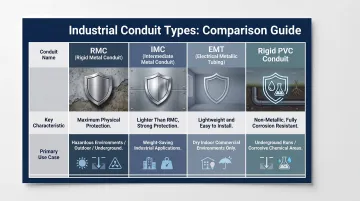
Conduit selection by environment:
| Conduit Type | Key Characteristic | Industrial Use Case |
|---|---|---|
| Rigid Metal Conduit (RMC) | Maximum mechanical protection | Hazardous locations, outdoor, underground |
| Intermediate Metal Conduit (IMC) | Lighter than RMC, same approval rating | Where weight savings are needed |
| EMT | Thinnest wall, lightest | Dry indoor locations only |
| Rigid PVC (Schedule 40/80) | Corrosion resistant, non-metallic | Underground, concrete-encased, corrosive areas |
Beyond conduit type, cable selection matters. Heavier gauge conductors handle high-amperage loads without overheating. Armored or TECK cables provide mechanical protection in exposed areas.
Power and control/instrumentation cables must also be physically separated — NEC requires it, and shielded instrumentation cable rated for 300V cannot share conduit with 480V power conductors.
One planning mistake that compounds over time: sizing cable infrastructure for current loads only. When production expands or new equipment is added, inadequate conduit fill leaves no room for additional conductors without expensive, disruptive rework. Plan for spare capacity from the start.
Grounding, Earthing, and Isolation Systems
Grounding and bonding systems are the safety foundation of every industrial installation. They create a low-impedance path for fault current to return to the source — enabling protective devices to operate quickly and preventing dangerous voltage buildup on equipment frames and structural steel that workers could contact.
NEC Article 250 establishes the framework: equipment grounding conductors must be sized per Table 250.122 based on the rating of the circuit overcurrent protective device. All metal raceways and equipment must be bonded.
Large facilities sometimes require supplemental grounding electrode systems or dedicated ground rings for sensitive electronic equipment to prevent ground noise that corrupts control signals.
Isolation and LOTO systems are equally critical. OSHA 29 CFR 1910.147 establishes the legal framework — and enforcement is real. From October 2022 to September 2023, OSHA issued 2,532 LOTO-related citations totaling $20.7 million in penalties. LOTO currently ranks among OSHA's top 10 most frequently cited standards.
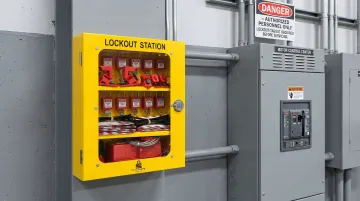
Isolation switches, lockout points, and interlocks must be designed into the installation from the beginning. Retrofitting them into an existing system is expensive, disruptive, and often incomplete.
Key Factors When Planning an Industrial Electrical Installation
Specifying individual components correctly is only part of the challenge. Planning decisions made early in a project have lasting effects on safety, cost, and operational flexibility.
Load Analysis and Environmental Conditions
Every component sizing decision flows from load calculations — and those calculations must account for motor starting currents, demand factors, and future equipment additions. Undersizing any element in the power chain from transformer to cable creates a system that fails under real operating conditions.
Environmental conditions determine component ratings just as much as electrical load does:
- Temperature extremes affect insulation classes and enclosure ventilation requirements
- Corrosive atmospheres require NEMA 4X enclosures and non-metallic conduit in affected areas
- Hazardous locations classified under NEC Article 500 (flammable gases, combustible dusts, ignitable fibers) require explosion-proof or dust-ignition-proof equipment rated for the specific Class, Division, and Group present
- Wet/washdown areas (common in food processing) typically require NEMA 4 or 4X enclosures and stainless hardware
Getting these ratings wrong creates both code violations and premature equipment failure.
Code Compliance and Scalability
Industrial electrical installations must meet NEC requirements, OSHA 29 CFR 1910 Subpart S, and any industry-specific regulations. One practical complication: as of early 2026, the 2023 NEC is in effect in 25 states, the 2020 NEC in 15 states, and the 2017 NEC in 3 states. Facilities must verify which edition applies in their jurisdiction before specifying equipment.
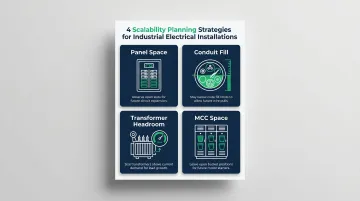
Those compliance requirements are fixed — scalability decisions are not, which makes them easier to get wrong. Industrial facilities evolve: production lines expand, equipment upgrades, automation gets added. Electrical infrastructure that can't absorb growth forces costly retrofits. Building in spare capacity from the start avoids that problem:
- Panel space — reserve breaker slots for future circuits
- Conduit fill — stay below code fill limits to allow wire additions
- Transformer headroom — size above current demand to accommodate load growth
- MCC space — leave open bucket positions for future motor starters
Partnering with a Qualified Turn-Key Contractor
Industrial electrical installations involve multiple interdependent disciplines — electrical design, mechanical integration, controls, and project management. Working with a contractor who can coordinate all of these under one scope eliminates the gaps and finger-pointing that occur when multiple contractors hand off work between trades.
IPS has delivered turn-key electrical and multi-discipline industrial project services since 1986, serving more than 2,000 clients across automotive, food processing, plastics, metals, and manufacturing sectors. Their electrical team handles VFD installation, switchgear, and control cabinet design and construction — coordinated alongside mechanical, millwright, and fabrication work within a single project management structure. One scope, one schedule, one point of accountability.
Common Mistakes to Avoid When Specifying Industrial Electrical Components
Four specification errors account for the majority of costly industrial electrical rework:
- Skipping load analysis before sizing components. Oversized transformers carry high no-load losses; oversized motors run at poor efficiency. Undersizing creates a system that fails under real operating demands. Both are avoidable with proper upfront engineering.
- Treating grounding and arc flash analysis as optional. These systems define whether the installation is safe and code-compliant. Cutting corners during design produces expensive retrofits, equipment failures, or safety incidents — none of which cost less than doing it right the first time.
- Designing only for current conditions. Insufficient conduit space, no spare circuit capacity, and already-obsolete components look like savings at project completion. Within a few years of production growth, they become expensive liabilities.
- Choosing a contractor on price alone. Industrial electrical work requires verifiable expertise in high-voltage systems, motor controls, process integration, and compliance. A contractor without that background introduces safety, code, and integration risks that far exceed any upfront cost difference.
Conclusion
Industrial electrical installations are complex, high-stakes systems where every component — from transformers and switchgear to motor controls, cabling, and grounding systems — plays a specific and interdependent role in keeping operations safe, efficient, and compliant.
Successful installations come down to three non-negotiable elements: disciplined upfront planning, accurate load analysis, and code-compliant design. Get these right, and the electrical infrastructure you build will serve the facility reliably for decades. Cut corners on any one of them, and you're compounding risk at every layer above it.
For facilities planning new installations, equipment upgrades, or expansions, working with a turn-key provider like IPS means electrical work is coordinated across mechanical, structural, and process disciplines from day one — by a single team accountable for the whole project, not pieced together across multiple contractors after the fact.
Frequently Asked Questions
What is industrial wiring installation?
Industrial wiring installation covers the design and setup of electrical systems in industrial facilities: power distribution, motor and control circuit wiring, and instrumentation cabling. These systems handle higher voltages, heavier loads, and harsher environmental conditions than commercial or residential wiring.
What is the difference between industrial and commercial electrical installation?
Industrial installations differ from commercial in several key ways:
- Operate at higher voltages (typically 480V three-phase and above)
- Involve complex controls, automation, and high fault-current-rated components
- Must withstand harsh environments and continuous heavy loads
Commercial installations serve lighter, more predictable loads in office, retail, or institutional settings.
What is the difference between industrial wiring and residential wiring?
Industrial wiring uses heavy-gauge conductors in conduit or armored cable running three-phase power to motors and machinery. Residential wiring uses lighter single-phase circuits for outlets, lighting, and appliances. Industrial systems also require far stricter compliance with safety codes and protective device coordination.
What are the requirements of industrial electrical installation?
Key requirements include:
- NEC and OSHA 29 CFR 1910 compliance
- Accurate load calculations and correct component ratings for voltage and environment
- Arc flash analysis, grounding and bonding per NEC Article 250
- Lockout/tagout provisions built into the installation for safe maintenance access
What are the three types of electrical installation?
Electrical installations are broadly categorized as residential (single-phase, low-load home systems), commercial (light-to-moderate loads for offices and retail), and industrial (high-voltage, heavy-load systems for manufacturing and processing facilities) — each governed by distinct design requirements and regulatory standards.
What is the difference between an electrician and an industrial electrician?
A general electrician installs and services electrical systems in homes and commercial buildings. An industrial electrician specializes in high-voltage systems, motor controls, PLCs, MCCs, and automation equipment. The role requires deeper knowledge of three-phase systems, industrial safety codes, and process controls.