Introduction
Moving an industrial plant is one of the most capital-intensive operations a manufacturer can undertake—and decommissioning is where the entire project succeeds or fails before a single piece of equipment touches a truck.
Operations managers and facility directors often underestimate what decommissioning actually involves. Decommissioning is a structured, multi-trade process with regulatory obligations, safety requirements, and reassembly consequences that ripple through every phase downstream.
If you're planning or evaluating a plant relocation—in automotive, food processing, metal forming, injection molding, or a similar manufacturing environment—this guide covers what you need to know:
- What decommissioning for relocation actually involves
- Each step in the process, in sequence
- Compliance obligations you can't afford to miss
- The mistakes that most reliably derail projects
Key Takeaways
- Decommissioning for relocation prioritizes asset preservation, not disposal—every component must arrive at the new site intact and reinstallable
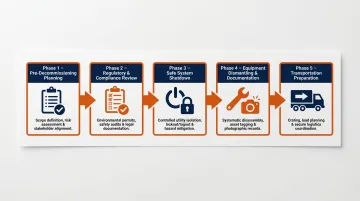
- Five structured phases drive the process: planning, compliance review, safe shutdown, dismantling and documentation, and transport preparation
- Environmental and safety compliance must run through every phase, not just at project close
- Poor tagging and documentation during dismantling is the leading cause of costly reassembly failures
- A single turnkey contractor eliminates coordination gaps between trades and keeps complex relocations on schedule
What Does It Mean to Decommission an Industrial Plant for Relocation?
Decommissioning is the systematic process of taking an industrial facility offline, disconnecting all systems and utilities, dismantling equipment, and preparing every asset for transport to a new location. In practice, that process involves coordinating multiple skilled trades, navigating regulatory requirements, and managing sequencing decisions that can make or break the reassembly at the destination site.
Relocation vs. Demolition: A Critical Distinction
When a facility is being demolished, the goal is clearance. When it's being relocated, the goal is reassembly readiness. Every component that leaves the current site needs to arrive at the next one intact, correctly identified, and reinstallable without guesswork.
That distinction changes how dismantling is approached: sequencing decisions, documentation requirements, and how rigging crews handle equipment all shift when the destination matters.
The Trades Involved
Decommissioning for relocation is a multi-trade project management challenge, not a single-trade task. A typical project requires coordinated execution across:
- Project managers — timeline, budget, and trade coordination
- Industrial millwrights — precision disassembly and alignment of stationary machinery
- Electricians — power system disconnection and documentation
- Riggers — heavy lifts and machinery transport
- Pipefitters — utility and process system isolation
- Hazardous material technicians — chemical residues, asbestos, PCBs
- Environmental consultants — EPA and state regulatory compliance
The scale of this work is significant: the industrial facility decommissioning and remediation market was valued at approximately $13.7 billion in 2024 and is projected to reach $21.5 billion by 2030.
The Step-by-Step Decommissioning Process for Plant Relocation
Decommissioning for relocation follows a structured lifecycle where each phase builds directly on the previous one. Compressing or skipping phases doesn't save time—it generates downstream problems that cost more to resolve than the time saved.
The five-phase framework below applies consistently across manufacturing environments, regardless of industry or facility size.
Step 1: Pre-Decommissioning Planning and Site Assessment
This phase establishes the entire project foundation. Without a completed planning phase, every subsequent step operates without a reliable roadmap.
A thorough planning phase includes:
- Site walk and layout mapping to physically document the facility as-is
- Full asset inventory with condition assessments and relocation vs. disposal decisions for every piece of equipment
- Defined project scope covering what relocates, what stays, and what gets disposed of
- Sequenced milestone timeline built around hard external constraints
- Budget with contingency for labor, equipment, compliance costs, and unexpected discoveries
The Kaizen Institute recommends beginning planning 1 to 3 years before the move for complex operations. At minimum, plan for 6 to 12 months of pre-work on a mid-to-large facility.
When IPS engages on a facilities closing or consolidating project, the scope starts here—establishing budgets, scheduling, and project management frameworks before any physical work begins.
Step 2: Regulatory Review and Compliance Assessment
Identify every applicable federal, state, and local requirement before any physical work begins. Projects stopped mid-execution by compliance violations are almost always traceable to this review being skipped or rushed.
Key regulatory areas to address:
| Requirement | Standard/Authority |
|---|---|
| Hazardous energy control | OSHA 29 CFR 1910.147 (Lockout/Tagout) |
| Hazard communication | OSHA 29 CFR 1910.1200 |
| Confined space entry | OSHA 29 CFR 1910.146 |
| Hazardous waste handling | EPA RCRA (42 U.S.C. 6901) |
| Oversized load transport | State DOT permit programs |
| Air permit notification | State environmental agency (e.g., Wisconsin DNR) |
Oversized load permits are state-administered—federal law establishes maximums (80,000 lbs gross on interstate highways), but each state runs its own permit program with different thresholds, routing restrictions, and escort requirements. Multi-state moves require permits in each jurisdiction.
IPS maintains OSHA/TOSHA-compliant safety policies and procedures as a baseline standard on every project and coordinates applicable regulatory requirements as part of project scoping.
Step 3: Safe System Shutdown and Hazardous Material Handling
The shutdown sequence is not flexible. Each step depends on the previous one being verified complete—not assumed complete.
OSHA estimates that proper lockout/tagout compliance prevents approximately 120 fatalities and 50,000 injuries annually. The risk is real—one study found that roughly 50% of work-related accidents in plants occur during maintenance outages.
The controlled shutdown sequence:
- De-energize electrical systems in a defined order with lockout/tagout devices applied per 29 CFR 1910.147
- Depressurize hydraulic and pneumatic systems and verify zero-energy state before proceeding
- Purge and isolate gas lines and chemical process systems — pressure dissipation must be verified, not assumed
- Catalog and segregate hazardous materials: oils, process chemicals, and refrigerants must be identified, documented, and staged for compliant handling before any dismantling begins
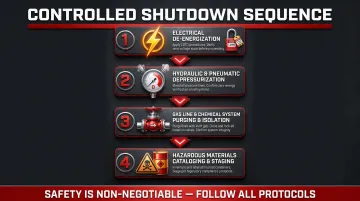
No dismantling begins until this sequence is complete and verified.
Step 4: Equipment Dismantling, Rigging, and Documentation
Systematic dismantling follows manufacturer disassembly specifications and is executed in reverse-assembly order. This is where relocation decommissioning diverges most sharply from demolition work.
Documentation requirements at this stage:
- Every component labeled with a unique identifier
- Components photographed in position before removal
- All items logged against the asset inventory
- PLC programs, control system configurations, and equipment parameters backed up
Without this documentation discipline, the new-site installation becomes an expensive reconstruction exercise. Undocumented modifications, missing anchor bolt patterns, and unknown utility connections are consistently cited as the source of extended downtime during reinstallation.
This phase requires coordinated multi-trade execution across millwrights, electricians, pipefitters, and riggers. For high-tonnage equipment, rigging plans must be engineered before the lift begins—not improvised on the day.
IPS integrates all required trades under a single project umbrella, with millwrights working directly alongside equipment OEMs to meet specs and tolerances. Single-lift capacity up to 800 tons and in-house trade coordination eliminate the handoff gaps that typically drive reinstallation delays.
Step 5: Transportation Preparation and Logistics Coordination
Equipment doesn't leave the origin facility until the receiving site is confirmed ready to receive it. Sending equipment before the destination can accept it creates expensive storage problems and compressed installation timelines.
Transit preparation includes:
- Custom crating and packaging for sensitive or precision components
- Heavy-duty strapping and load securing for machinery
- Protective coatings and covers for precision surfaces
- Oversized load permit procurement for each state in the transport route
- Transport routing analysis — bridge clearances, weight limits, road restrictions
- Carrier selection and scheduling tied to receiving site readiness
IPS handles oversized load permitting and border crossing logistics across all jurisdictions — a practical requirement for any relocation spanning multiple states or crossing into Mexico or Canada.
Environmental and Safety Compliance During Decommissioning
Compliance runs through every phase of decommissioning, not just the final steps before vacating.
Waste Management Requirements
Under EPA RCRA, hazardous waste is regulated from generation through final disposal. During decommissioning:
- Hazardous and non-hazardous waste streams must be separated at the point of generation
- Hazardous waste must be handled by certified disposal facilities
- All hazardous waste transported off-site requires a Uniform Hazardous Waste Manifest (EPA Form 8700-22) under 40 CFR Part 262
- Recyclable metals and components should be identified and processed through appropriate channels
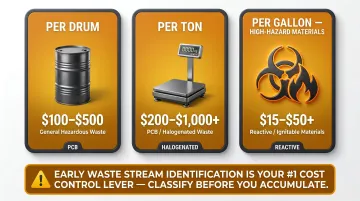
Cost ranges for hazardous waste disposal vary widely: $100–$500 per drum, $200–$1,000+ per ton, and $15–$50+ per gallon for high-hazard materials requiring incineration. Early waste stream identification during planning is the primary lever for controlling these costs.
Site Remediation Obligations
If the facility processed chemicals, petroleum products, or heavy metals, soil and groundwater testing is required before vacating. Two federal frameworks create this obligation:
- CERCLA (Superfund): Establishes strict, retroactive liability for hazardous substance releases. Liability follows the company after the site is vacated. Unaddressed contamination doesn't disappear when you move.
- RCRA Corrective Action: Requires facilities that treated or stored hazardous waste to investigate and clean up contamination as a condition of closure.
Beyond these two frameworks, federal NEPA review applies only to major federal actions. A purely private relocation without federal permits or funding doesn't trigger the federal EIA process. Several states, including California, Washington, and New York, have equivalent statutes that may apply based on local permitting triggers. Conduct an environmental assessment regardless—the cost of discovery after the fact is far higher than the cost of assessment before you leave.
Worker Safety Requirements
Specific OSHA standards govern the highest-risk activities during decommissioning:
- 29 CFR 1910.147 — Lockout/Tagout for hazardous energy control
- 29 CFR 1910.146 — Permit-required confined space entry (vessels, tanks, pits previously active in production)
- 29 CFR 1910.1200 — Hazard communication and chemical exposure training
- 29 CFR 1910.132 — PPE selection, provision, and employee training
Air quality and exposure monitoring is required during chemical system dismantling. Fall protection applies to elevated equipment removal. Confined space entry into previously active vessels requires atmospheric testing before and during entry.
Key Factors That Affect the Decommissioning Process
Industry and Process Complexity
The technical depth of decommissioning varies significantly by industry:
- Automotive assembly lines with integrated robotics require ANSI/RIA R15.606-compliant energy isolation, multi-axis controller disconnection, and safety interlock documentation
- Food processing facilities with ammonia refrigeration systems trigger OSHA PSM requirements (29 CFR 1910.119) and EPA Risk Management Program obligations if anhydrous ammonia exceeds 10,000 lbs on site
- Rubber and chemical extrusion facilities involve solvent and process chemical purging with substance-specific exposure monitoring requirements
No single ANSI or ASTM standard governs manufacturing plant decommissioning for relocation specifically—applicable requirements are drawn from general OSHA and EPA frameworks applied to industry-specific conditions.
Timeline Constraints
Hard external deadlines compress the margin for error:
- Lease termination dates
- Utility disconnection schedules
- Regulatory notification deadlines
- Production restart targets at the new site
Miss any one of these and the downstream consequences compound fast. The Kaizen Institute recommends starting the planning process 1 to 3 years out for complex operations — a timeline most project teams dismiss as excessive until they're mid-project and behind schedule.
Hazardous Materials
The presence of asbestos-containing insulation, PCB-containing electrical equipment, ammonia refrigeration systems, or industrial solvents escalates both regulatory burden and project cost. Key regulatory frameworks:
- Asbestos: EPA NESHAP (40 CFR Part 61, Subpart M) and OSHA 29 CFR 1926.1101
- PCBs: TSCA (40 CFR Part 761) — equipment at 500+ ppm classified as PCB Transformer; disposal required within one year of removal from service
- Ammonia: OSHA PSM (29 CFR 1910.119) and EPA RMP (40 CFR Part 68) above threshold quantities
Early hazmat identification during the site assessment is the single most effective cost control action available.
Late discovery during active decommissioning triggers work stoppages, emergency contractor mobilization, and expedited disposal fees that can multiply planned removal costs several times over.
Common Mistakes to Avoid When Decommissioning for Relocation
1. Inadequate tagging and documentation during dismantling
Teams that skip systematic labeling and photographic records at the origin site consistently face costly delays, incorrect installations, and extended downtime at the destination. Unlike demolition, where documentation is primarily for regulatory records, relocation decommissioning depends on accurate component-level documentation for successful reassembly.
2. Starting physical work before planning is complete
Teams that begin dismantling before completing the site assessment, regulatory review, and asset inventory regularly encounter:
- Unexpected hazmat discoveries mid-project
- Equipment damage from incorrect disassembly sequencing
- Compliance violations triggering stop-work orders
The recovery time from these failures exceeds what the planning phase would have taken.
3. Fragmenting the work across multiple separate contractors
When no single entity owns the full scope, coordination gaps form between trade handoffs. Accountability for damage or errors becomes contested. The project management burden shifts to the client's internal team, which is already managing a production facility in transition.
Consolidating under a single contractor like IPS eliminates these gaps. A turn-key model provides:
- One point of accountability for the full project scope
- No fee layering between subcontractors
- Faster resolution when issues arise — with no contested blame between trades
- Reduced management burden on the client's internal team
Frequently Asked Questions
What does it mean to decommission an industrial plant?
Decommissioning is the process of safely taking an industrial facility offline, disconnecting and dismantling all equipment and systems, and preparing the site and assets for relocation, repurposing, or permanent closure. The work spans project management, trade execution, regulatory compliance, and logistics coordination.
What are the main steps in industrial plant decommissioning?
The five core phases are: pre-decommissioning planning and site assessment, regulatory and compliance review, safe system shutdown and hazardous material handling, equipment dismantling and documentation, and transportation preparation and logistics coordination.
How is decommissioning different from demolition or dismantling?
Demolition focuses on structural destruction and removal of buildings. Dismantling is one sub-phase within a broader decommissioning process. Full decommissioning—especially for relocation—is a comprehensive multi-phase effort aimed at safely retiring an entire facility while preserving assets for reinstallation at a new site.
Is industrial plant decommissioning legally required?
No single federal statute mandates "decommissioning" by name. However, OSHA workplace safety standards, EPA hazardous waste regulations under RCRA, and state environmental requirements collectively impose specific obligations around hazardous materials, waste disposal, and site remediation that require a structured approach.
How much does hazardous waste disposal cost during decommissioning?
Costs range from $100–$500 per drum and $200–$1,000+ per ton for hazardous waste, with high-hazard materials (reactive, PCB, halogenated) reaching $15–$50+ per gallon. Costs vary by waste type, volume, disposal method, and location. Early waste stream identification during planning is the primary lever for keeping these costs manageable.
What is an industrial plant decommissioning service?
A decommissioning service manages some or all phases of the decommissioning process on behalf of the plant owner. A turn-key provider like IPS integrates planning, compliance coordination, dismantling, rigging, and logistics under a single contract. This eliminates the coordination gaps and accountability disputes that arise when separate contractors manage each trade independently.